Why an AI Model Marketplace Is the Smarter Way to Access Multiple LLMs
@uberllmaimodelmarketplaceguide
November 5, 2026 · 7 min read
Building software that uses large language models has become a standard part of many development stacks. Teams integrate GPT, Claude, Gemini, or open-weight models into everything from chatbots to data pipelines. But managing multiple API keys, tracking different pricing structures, and dealing with rate limits from each provider quickly becomes a headache. This is where an AI model marketplace changes the game. Rather than juggling direct integrations one by one, you work through a single platform that routes requests to the best available model for your task.
The concept is straightforward. A marketplace aggregates many models behind one API. You send a request with your prompt and some metadata, and the platform decides which underlying model handles it. Some marketplaces let you specify a preferred model or a fallback chain. Others optimize for latency, cost, or a combination of factors. The result is a simpler development process and more flexibility when models change or new ones appear.
How an AI Model Marketplace Changes Your Workflow
When you work directly with a single model provider, you lock yourself into that provider's roadmap and pricing. If a cheaper or better model launches elsewhere, you have to rewrite integration code, update authentication, and test thoroughly. An AI model marketplace insulates you from that churn. You write your code once against the marketplace API, and the marketplace handles the switching behind the scenes.
This becomes especially valuable for teams that need to support multiple use cases. A customer support bot might need a fast, cheap model for simple queries and a more capable one for complex issues. A content generation pipeline might want to compare outputs from several models before picking the best result. Without a marketplace, you would need separate integrations, separate billing, and separate monitoring for each model. With one, you get a single dashboard, one API key, and consolidated usage logs.
The Economics of Routing Through a Marketplace
Direct API access from model providers is priced at list rates. Those rates are what you see on their pricing pages. An AI model marketplace can offer lower effective prices because it aggregates demand and routes requests to sellers who can provide the same model at a discount. This competitive routing means you might access the exact same GPT-4 or Claude 3.5 response through the marketplace for less than you would pay going direct.
That said, the savings depend on volume and model popularity. For very low traffic, the convenience of a single integration might outweigh any minor cost difference. For high volume, the marketplace model often works out cheaper because the platform's sellers bid for your traffic. It is worth testing both approaches with your actual usage patterns to see which yields better economics for your specific workload.
What to Look For in an AI Model Marketplace
Not all marketplaces are built the same. Here is what to check before you commit your integration to one.
- Model selection. Does it have the models you actually need? The best marketplace covers both frontier models from major labs and popular open-weight alternatives. If it only has a few options, you might still need direct integrations for the rest.
- Latency and reliability. Because the marketplace routes through third-party sellers, response times can be less predictable than going direct. Look for a platform that publishes uptime stats and allows you to set latency thresholds.
- Data handling. Understand how your prompts and responses are handled. Does the marketplace share data with seller nodes? Do they have a privacy policy that matches your compliance requirements? For sensitive data, you may need a marketplace that guarantees no data logging by sellers.
- Fallback logic. If the primary model is down or too slow, does the marketplace automatically retry on a different seller or model? Good marketplaces let you define fallback chains so your application stays responsive even when a specific endpoint fails.
- Pricing transparency. The marketplace should show you how much each request costs in real time. Some platforms add a markup on top of the seller's price. Others take a cut from the seller and show you the net rate. Make sure you understand the fee structure before scaling up.
Practical Trade-Offs
Working through an AI model marketplace introduces a dependency you would not have with direct API access. If the marketplace goes down, your access to every model goes down with it. You lose the ability to independently switch to a direct connection without code changes. Some teams mitigate this by keeping a direct API key as a fallback and using the marketplace for primary traffic. That adds complexity but gives you an escape route.
Another trade-off is latency. Direct API calls travel to a single endpoint. Marketplace calls go to a routing layer, which then forwards to a seller. That extra hop can add tens to hundreds of milliseconds, depending on the seller's location and the marketplace's routing logic. For interactive chat applications, this delay might be noticeable. For batch processing, it usually does not matter. You should benchmark your actual use case to decide.
There is also the question of vendor lock-in. The whole point of a marketplace is to reduce lock-in by abstracting away individual providers. But you become locked into the marketplace itself. If you build deep integrations that rely on marketplace-specific features like prompt caching or custom fallback logic, switching away later is not trivial. Choose a marketplace that offers a standard OpenAI-compatible API or something close to it, so you retain the option to move.
Realistic Use Cases
A common pattern is using a marketplace for experimentation. Teams can test the same prompt against five different models without writing five integrations. They can compare output quality, speed, and cost side by side. Once they settle on a model for production, they can either stay on the marketplace or switch to a direct integration for lower latency. The marketplace acts as a sandbox that reduces the upfront cost of evaluation.
Another pattern is cost-sensitive batch processing. If you need to classify thousands of customer emails or generate product descriptions at scale, even small per-request savings add up. An AI model marketplace can route those requests to the cheapest available seller that meets your quality bar. Just make sure you set a minimum model capability so you do not end up with a cheap model that gives poor results.
What the uberllm ai model marketplace Brings to the Table
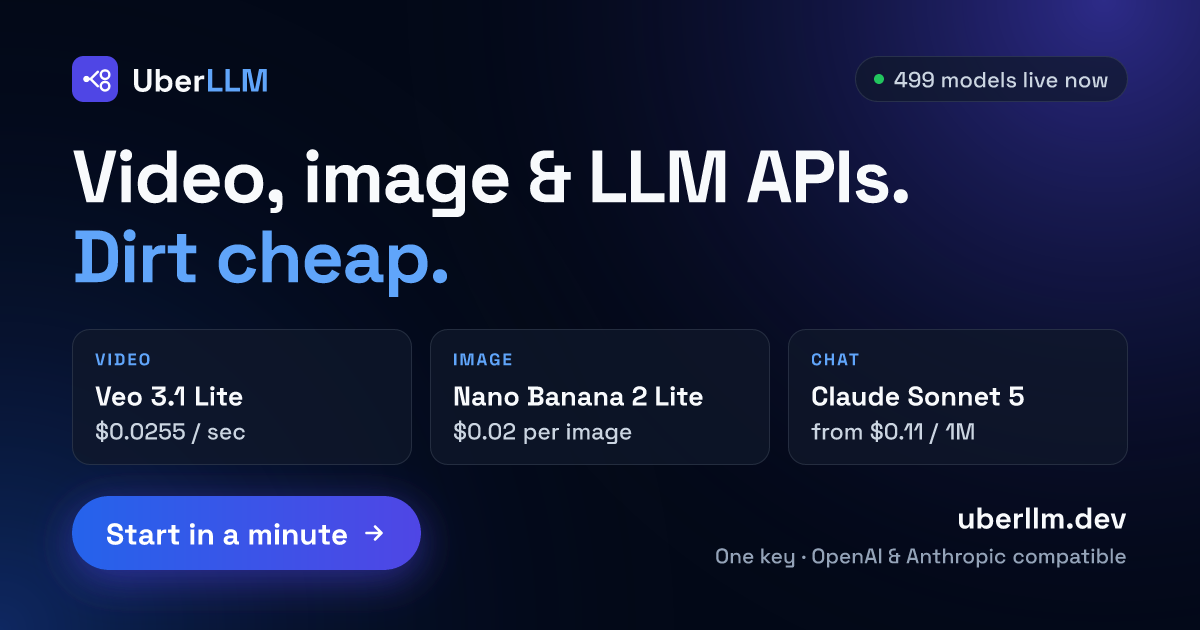
The uberllm ai model marketplace is a specific implementation of this concept. It provides a single API key that unlocks access to multiple models, with pricing that can be lower than list rates because of competitive seller routing. The platform handles the complexity of matching requests to sellers, managing authentication, and collecting usage data. For developers who want to avoid the overhead of maintaining separate integrations for each model, this kind of marketplace simplifies the stack considerably.
Using the uberllm ai model marketplace means you can add a new model to your application by simply updating your request parameters. You do not need to sign up for another service, generate another API key, or modify your code. That flexibility is valuable for teams that iterate quickly or operate in fast-changing domains like generative AI, where new models appear every few weeks.
Final Thoughts on the Marketplace Approach
An AI model marketplace is not a silver bullet. It adds a layer between you and the model, which comes with latency, reliability, and trust considerations. But for many teams, the trade-offs are worth it. The ability to access a wide range of models through one integration, the potential for cost savings through competitive routing, and the reduced maintenance burden make it an attractive option.
If you are evaluating whether to use a marketplace, start with a simple test. Pick a representative task, run it through the marketplace and through a direct API, and compare the results on latency, cost, and output quality. That hands-on experiment will tell you more than any generic analysis. And if you find that the marketplace fits your needs, the uberllm ai model marketplace is one of the platforms worth putting on your shortlist for evaluation.